STANDARD FOR CHILDREN’S COTTON TOWELS: ENSURING ABSOLUTE SAFETY FOR SENSITIVE SKIN FROM A TECHNICAL PERSPECTIVE
For infants and young children, the skin is not only a protective barrier but also the most vulnerable organ, easily damaged by external influences. Among the most frequently used items in a baby’s daily routine are bath and face towels. However, not all products available on the market meet the rigorous standard for children’s cotton towels. Understanding pH levels and safety certifications allows parents to make informed choices, directly protecting their children from skin inflammation and long-term allergies. At Minh Khai Textile, a long-standing specialist in cotton towel weaving, we believe every child’s product is a commitment to absolute safety, where modern textile technology must be combined with the producer’s highest level of dedication.
1.Why a specific and rigorous standard is required for children’s skin
A child’s skin, especially in newborns, has a very thin epidermis and an incomplete natural barrier. Its thickness is only about one-third to one-half that of an adult’s skin, making it highly susceptible to absorbing harmful chemicals from textiles if the quality is compromised. A rough towel or one containing dye residues can trigger atopic dermatitis, rashes, or even systemic poisoning through skin absorption. Furthermore, children’s skin has fewer natural moisturizing factors, so even slight friction from sub-standard fibers can cause micro-tears invisible to the naked eye.
Consequently, a standard for children’s cotton towels cannot be the same as that for regular household towels. At Minh Khai Textile, the cotton fiber selection process is extremely strict, starting right from raw material imports. Fibers must be long-staple varieties with natural resilience and softness, ensuring they do not become stiff after multiple washes. Every stage from spinning to weaving must achieve the highest purity. We establish completely isolated workflows for children’s towel production lines to avoid cross-contamination from other industrial orders. This ensures that every towel leaving the machine is as clean and safe as the love parents give to their children.
2.The critical importance of pH balance and Minh Khai’s control techniques
pH is one of the most vital technical indicators of textile safety for children. Healthy skin is slightly acidic, maintaining a natural pH between 4.5 and 6.0. This environment creates an “acid mantle” that protects the skin against bacteria and environmental pathogens. If a towel is not pH-compatible, it becomes a factor that destroys this protective barrier the moment it touches the skin.
A towel meeting the standard for children’s cotton towels must fall within a safe pH range, close to that of human skin. If a towel is too alkaline from detergents or too acidic from dye residues, it will dry out the baby’s skin, causing dehydration and allowing bacteria to enter. At Minh Khai Textile, following reactive dyeing and bio-enzyme washing, every batch is electronically tested for pH in our laboratory. Only when it reaches a neutral or slightly acidic level, fully compatible with the most sensitive skin, is the towel allowed for packaging. For us, pH control is not just a technical requirement; it is an ethical obligation to protect our youngest customers.
3.International safety certifications: A reliable filter for informed parents
In a modern textile world filled with various dyeing chemicals, the naked eye cannot distinguish between a truly clean product and a hazardous one. Instead, parents should rely on global certification systems as the most transparent filters. The OEKO-TEX Standard 100 is the global gold standard that Minh Khai Textile has maintained for years. To achieve Class 1 certification specifically for infants, the product must pass rigorous tests for hundreds of harmful substances, including pesticides, heavy metals, carcinogenic amines, and potential allergens.
Additionally, our organic cotton lines strive for global GOTS certification. This ensures that no harmful chemicals, fertilizers, or GMO seeds are used from farming to the final weaving stage. Prioritizing products with these certificates from a specialist in cotton towel weaving like Minh Khai is the best solution for long-term health. We invest heavily in closed high-pressure dyeing systems that bond colors to the fiber core through physical and enzymatic methods, eliminating the need for metal-based dyeing aids and ensuring the towel remains safe and vibrant over time.
4.Linting control and sustainable fiber bonding in production
Besides chemicals, the standard for children’s cotton towels focuses heavily on linting or shedding. Children often put towels in their mouths or rub them against their eyes and nose. If a towel sheds fibers, these tiny pieces can enter the respiratory tract, causing coughing, lung irritation, or eye inflammation. This is a technical challenge that small-scale or manual weavers often struggle to overcome.
At Minh Khai Textile, children’s towels undergo specialized surface treatment using high-pressure vacuum systems. This technology removes all weak fibers and lint generated during weaving. A standard towel must have strong fiber bonds and a smooth surface that does not shed even under heavy friction or industrial washing. Parents can check this by wiping the towel under a bright light; if no dust particles are visible, it indicates a professional lint-control process. Minh Khai Textile takes pride in its advanced weaving technology that protects a baby’s delicate respiratory system.
5.Minh Khai Textile’s vision and practical advice for parents
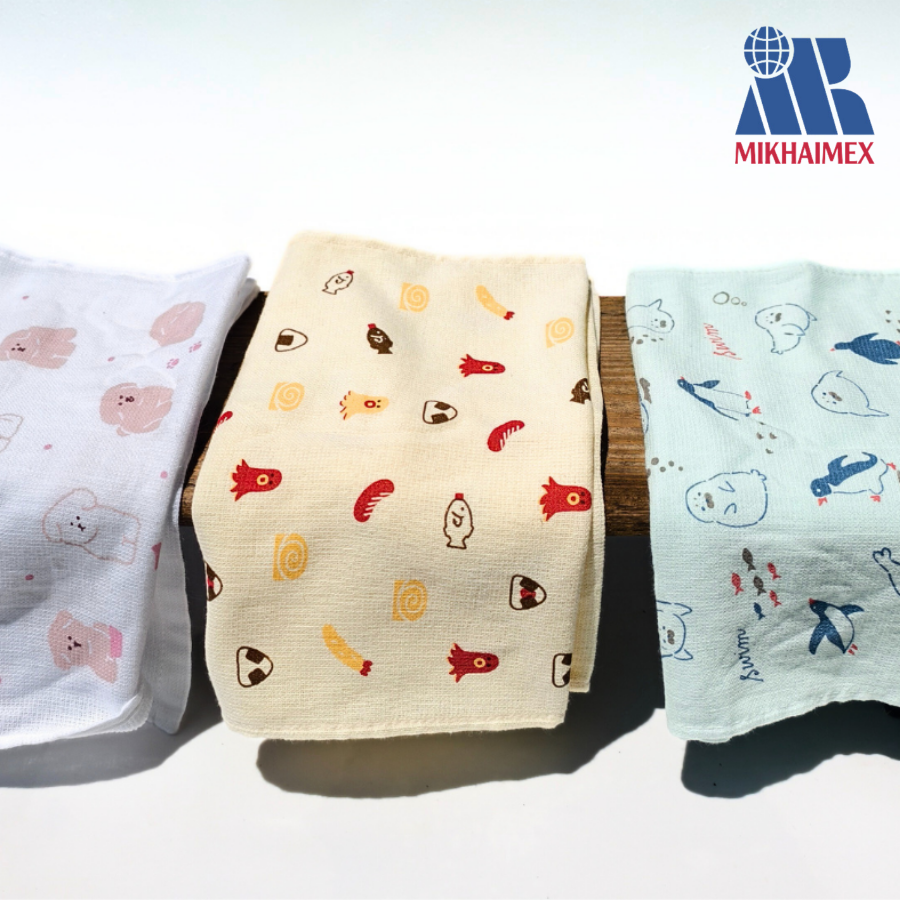
We believe the standard for children’s cotton towels lies in the depth of technical safety rather than just eye-catching patterns. To ensure the best care, parents should choose light colors such as white, cream, or pastel shades, as these use fewer dyes and minimize chemical residue risks.
Furthermore, pay attention to the towel’s thickness. Towels for young children should not be overly thick, as they retain moisture longer, creating a breeding ground for bacteria if not dried properly. A towel with moderate thickness and natural hollow fiber structure provides high absorbency and quick drying. Minh Khai Textile, a specialist in cotton towel weaving for generations, is always ready to accompany parents in providing safe, international-standard products. Choosing a reputable local brand with transparent technical standards is the smartest investment for the health and sustainable future of your child.