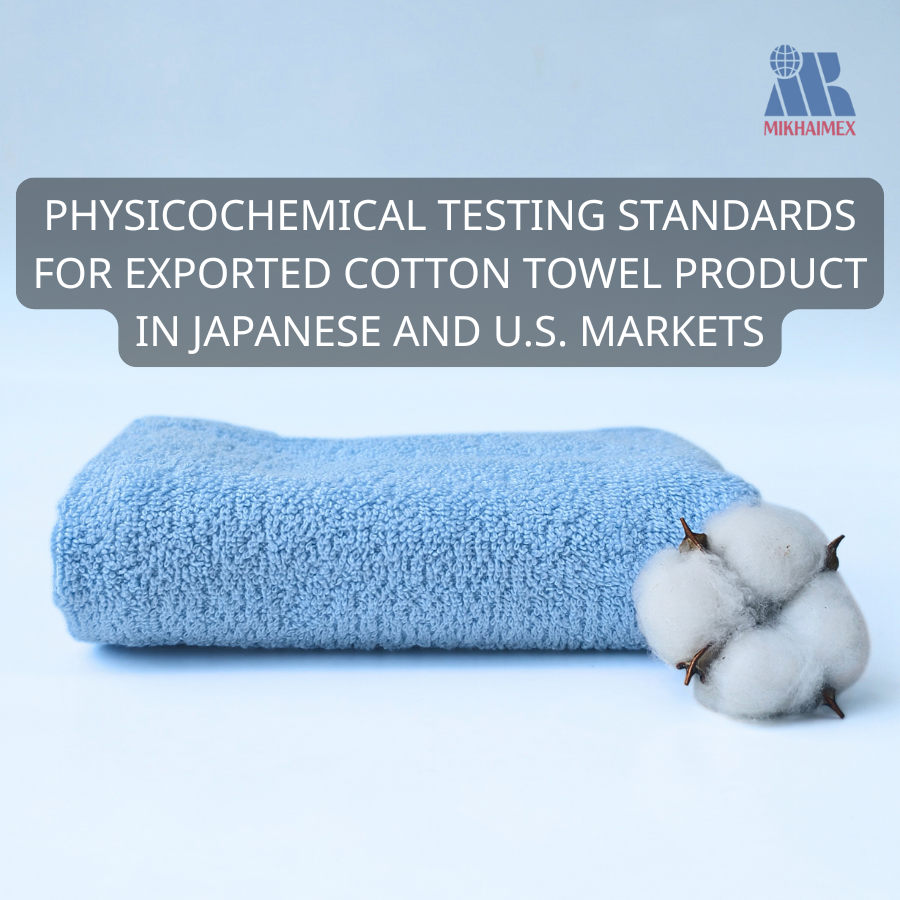
PHYSICOCHEMICAL TESTING STANDARDS FOR EXPORTED COTTON TOWEL PRODUCT IN JAPANESE AND U.S. MARKETS
I. THE IMPORTANCE OF PHYSICOCHEMICAL INDICATORS IN COTTON TOWEL EXPORT STRATEGIES
In the context of international economic integration, the Vietnam textile industry in general, and the cotton towel sector in particular, are facing increasingly stringent technical barriers. For an exported cotton towel product to penetrate and maintain a foothold in the world’s two largest markets, Japan and the United States, meeting physicochemical testing standards is not only a legal requirement but also a benchmark of manufacturer prestige. Japan is renowned for its meticulousness and strict safety requirements, while the United States focuses on functional performance and transparency regarding chemical composition origins.
Physico-chemical testing ensures that every exported cotton towel possesses a stable fiber structure, standardized absorbency, and, crucially, no harmful chemical residues. For Vietnamese enterprises, understanding and mastering these testing processes is the key to maximizing the benefits of Free Trade Agreements. An exported cotton towel product that meets physicochemical standards will minimize the risk of returns or destruction at borders, while building sustainable trust with international retailers and consumers who are highly sensitive to products in direct contact with the skin.
II. TESTING STANDARDS IN THE JAPANESE MARKET: RIGOROUS BIOLOGICAL SAFETY
The Japanese market has always been considered the most difficult test for exported cotton towel items. Japanese consumers are particularly concerned about antibacterial properties, softness, and chemical content in fabrics. Leading standards here are often based on JIS (Japanese Industrial Standards). One of the most important physical factors is capillarity and the ability to absorb water in an extremely short time. An exported cotton towel to Japan must have an absorption speed of less than 5 seconds to ensure immediate dryness after use.
Chemically, Japan strictly controls Formaldehyde content, especially for infant towels or face towels. The Formaldehyde index must be near zero to avoid skin irritation. Additionally, an exported cotton towel must undergo colorfastness tests against perspiration, light, and friction according to JIS L 0841 to L 0843 standards. The Japanese also require testing for heavy metal residues and prohibited Azo dyes. If even a minor indicator fails to meet requirements, the entire shipment of exported cotton towel products will be denied entry, demanding a production process that is extremely clean and transparent from fiber selection to finishing.
III. TESTING STANDARDS IN THE U.S. MARKET: PERFORMANCE AND ENVIRONMENTAL RESPONSIBILITY
In contrast to Japan’s focus on biological safety, the U.S. market places heavy emphasis on long-term performance and compliance with Consumer Product Safety Commission (CPSC) regulations. Any exported cotton towel line entering the U.S. must comply with the Consumer Product Safety Improvement Act (CPSIA). Physical testing in the U.S. focuses heavily on tensile strength, tear strength, and flammability according to 16 CFR Part 1610 standards, which is particularly vital for bath towels and bathrobes. A U.S.-standard exported cotton towel must maintain its fiber structure after hundreds of industrial wash and dry cycles at very high temperatures.
Chemically, the U.S. strictly controls Lead and Phthalates content in dyes and decorative details. U.S. importers often require an exported cotton towel to hold Oeko-Tex Standard 100 certification or comply with the Restricted Substances List (RSL). Chlorine Resistance is also a key physicochemical indicator, as Americans typically use strong detergents when washing whites. If an exported cotton towel is not meticulously dyed, fading or fiber hardening will occur quickly, reducing the competitiveness of Vietnamese businesses on the shelves of U.S. supermarkets like Walmart or Costco.
IV. PHYSICOCHEMICAL QUALITY MANAGEMENT PROCESS IN PRODUCING EXPORTED COTTON TOWELS
To meet the two distinct sets of standards from Japan and the U.S., the production process for an exported cotton towel must be established under a strict quality management system from input to output. First, the input Cotton fiber inspection must ensure standard staple length and the absence of chemical impurities. The weaving process must control yarn tension to ensure the exported cotton towel has a uniform loop density, keeping the GSM (weight) index stable according to order requirements. Physical control starts from the very first meters of raw fabric on the loom.
The next stage is dyeing and finishing, which determines the chemical indicators of the exported cotton towel. Factories must use RO water filtration systems and premium dyes free of toxic aromatic Amine groups. After dyeing, towels must be softened using biological agents instead of synthetic chemicals to ensure a neutral pH from 5.5 to 7.0. Before packaging, samples from each batch of exported cotton towel products must be sent to independent testing centers such as Intertek, SGS, or BV for final physicochemical tests. Only with a Pass Report are the goods eligible to be loaded onto ships bound for international ports in Japan or the U.S.
Criteria for Choosing Towels for Hotels and Homestays – Small Investment, Big Impact
V. MINH KHAI TEXTILE FACTORY: INTERNATIONAL STANDARDS IN EVERY EXPORTED COTTON TOWEL PRODUCT
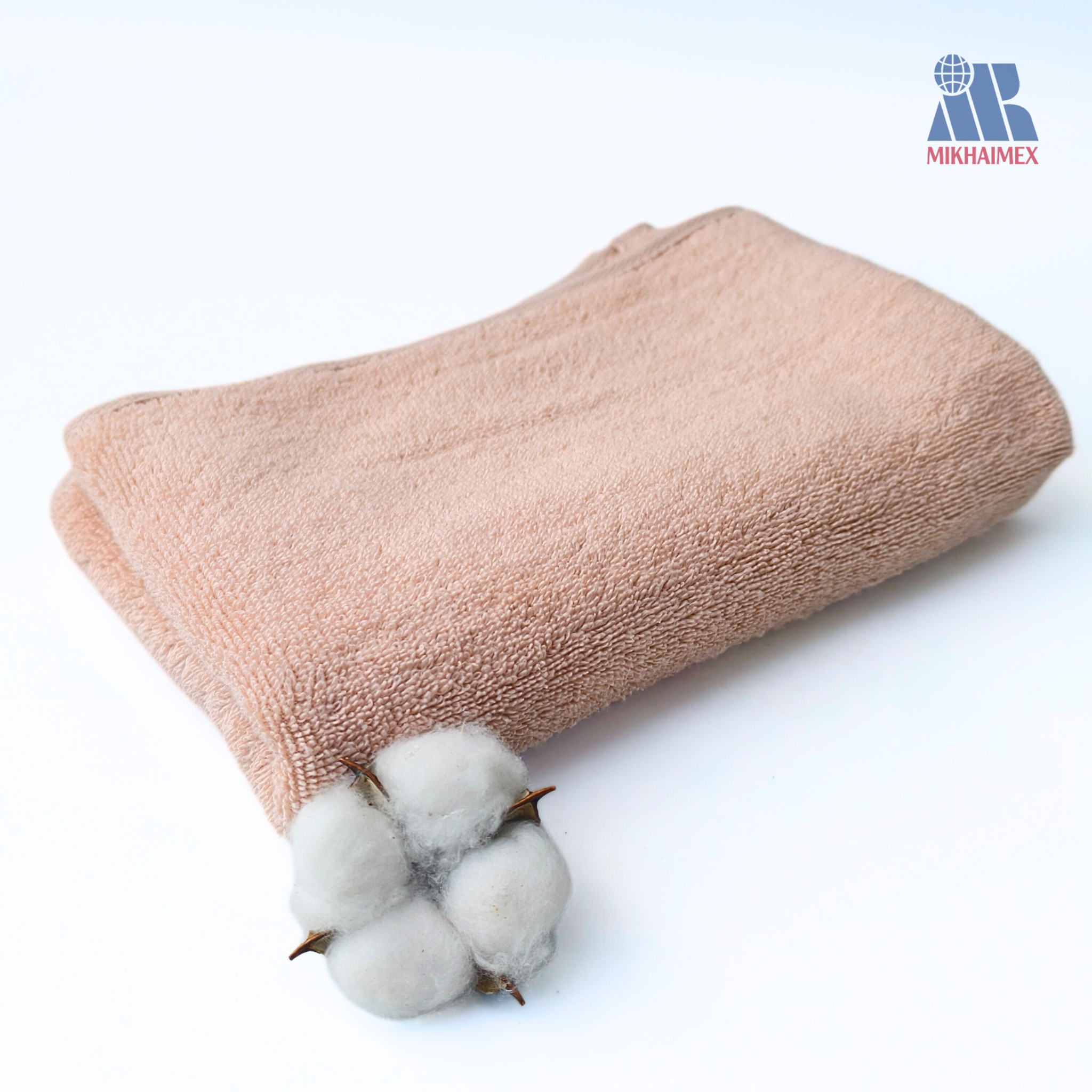
Minh Khai Textile Joint Stock Company (Minh Khai Textile) is proud to be one of the leading units in meeting the strictest physicochemical standards to bring exported cotton towel products to the global stage. With a modern internal laboratory system and a team of experienced dyeing engineers, Minh Khai Textile Factory strictly controls all technical indicators before products reach international partners. We understand that every exported cotton towel to Japan or the U.S. carries not only economic value but also the reputation of a Vietnamese brand.
Exported cotton towel products from Minh Khai Textile always achieve superior physicochemical indicators:
-
Optimal colorfastness: Towels maintain their original shade after many strong launderings, reaching level 4-5 according to international standards.
-
Safe chemical content: Absolutely free of Formaldehyde, Azo, or heavy metals, achieving Oeko-Tex Standard 100 certification, safe for even the most sensitive skin.
-
Absorbency and mechanical durability: Minh Khai exported cotton towel products feature superior water absorption speed and high tear resistance, proving durable in industrial environments.
-
Clear traceability process: Minh Khai Textile provides full physicochemical certificates for each exported cotton towel batch, giving partners peace of mind during customs clearance and distribution.
Choosing an exported cotton towel from Minh Khai Textile is choosing a guarantee of physicochemical quality and strict compliance with international technical barriers. We are committed to continuing our investment in technology and people to bring the finest exported cotton towel products from Vietnam to customers worldwide, asserting our position as a professional and sustainable textile manufacturer.