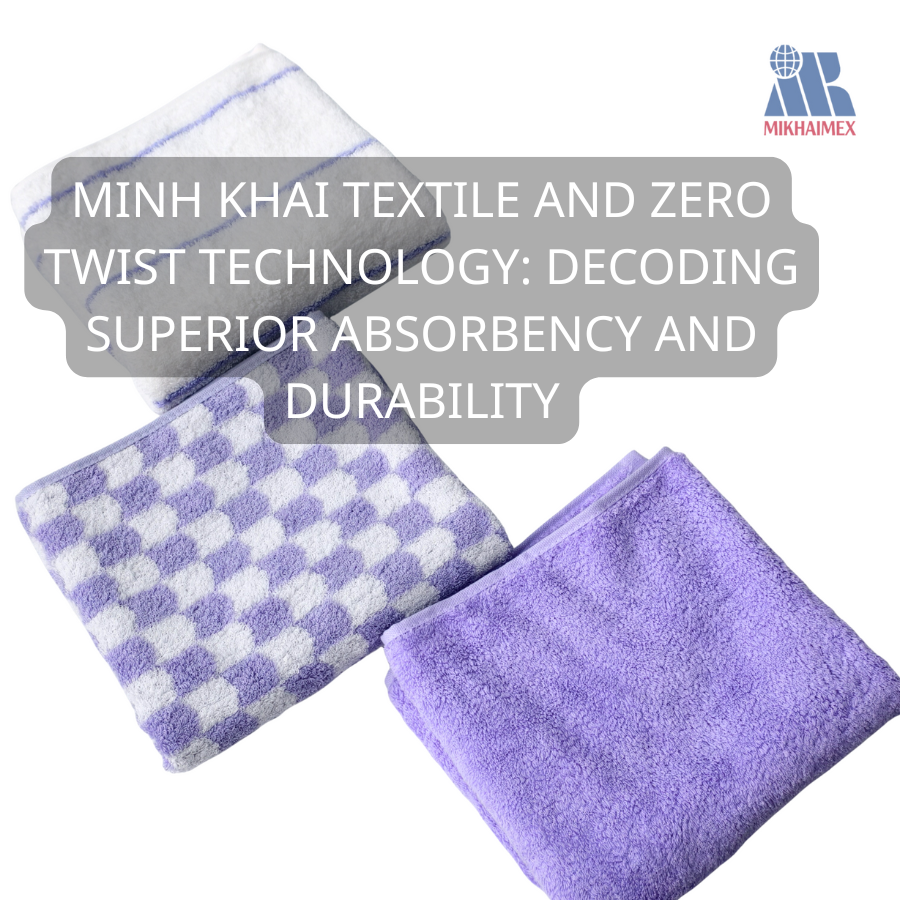
MINH KHAI TEXTILE AND ZERO TWIST TECHNOLOGY: DECODING SUPERIOR ABSORBENCY AND DURABILITY
I. Market Context and the Demand for High-Performance Towels
In the global towel textile industry, competition no longer revolves solely around price or production scale, but has strongly shifted towards performance and user experience. Modern consumers, especially in developed markets such as Japan, Europe, and North America, demand more from a towel: they must be extremely soft, super absorbent, and most importantly, fast-drying to prevent bacterial growth and reduce energy costs in washing and drying.
Traditional weaving technologies often face a trade-off: to achieve softness, the twist of the yarn must be reduced (low twist), but this compromises tensile strength and makes the towel prone to linting. Conversely, high-twist yarn is durable but rough and less absorbent. This challenge required leading manufacturers to seek a technical breakthrough, which is where Zero Twist technology emerged.
The application of advanced technologies like Zero Twist technology is not just a competitive product advantage, but also proof of the innovation capabilities and market responsiveness of Vietnamese textile and garment enterprises, including Minh Khai Textile.
II. Decoding Zero Twist Technology: A Breakthrough in Fiber Structure and Weaving
Zero twist, also known as non-twist weaving technology, is a significant advance in cotton spinning and weaving techniques. The name originates from the fact that the cotton fibers used to form the terry loops on the towel surface are maintained at an extremely low twist, almost zero.
Zero twist technology operates based on the following fundamental principles:
Non-twisted fiber: Instead of using torsional force to hold short cotton fibers together (like traditional yarn), this technology uses a special bonding method, often involving a water-soluble binder or mechanical reinforcement techniques, to maintain the fiber structure. After the fabric is woven and undergoes the finishing/dyeing process, the binder is washed away, leaving the cotton fibers nearly straight. Maximizing Surface Area: When the fibers are not tightly compressed by twisting, they become fluffier, with more void space within and between the fibers. This significantly increases the surface area of the cotton fibers exposed to water, directly boosting absorbency to its maximum level. Lightweight and Fluffy Weave Structure: The result is a non-twisted cotton towel that is incredibly soft, voluminous, and lighter than traditional towels of the same GSM (Grams per Square Meter). This is why zero twist towels often convey a feeling of luxury and premium quality. Thanks to Zero Twist technology, the towel resolves the conflict between softness and performance, providing a superior user experience.
III. Superior Advantages: Absorbency, Quick-Drying, and User Experience
The difference made by Zero Twist technology is not just in the production technique but is clearly reflected in the core features of the towel product:
Superb Absorbency: Because the cotton fibers are not compressed by twisting, the capillary action of the fibers is maximized, helping the towel absorb a larger amount of water significantly faster than conventionally woven towels. This feature is particularly important in premium applications such as hotel bath towels or sports towels. Faster Drying Speed: The porous and lightweight structure of the zero twist fiber allows air to circulate more easily through the gaps between the fibers. This not only helps the towel dry faster after use, reducing musty odors, but also significantly saves energy and time during industrial drying, a major economic benefit for large supply chains. Softness and Luxurious Feel: Zero twist towels possess a velvet-like softness, providing a pleasant and premium skin-contact experience. This is a key factor creating distinction in the retail and gift towel segments. However, an inherent challenge of Zero Twist technology is durability. Non-twisted fibers are generally more prone to breakage or linting if not properly reinforced. Therefore, selecting high-quality long-staple cotton (such as Pima, Supima) is mandatory to maintain the necessary tensile strength.
IV. Technical Challenges and the Strategy for Optimizing Durability
Despite the advantages in softness and absorbency, manufacturers utilizing Zero Twist technology face two major technical challenges: maintaining tensile strength and controlling linting.
Selecting Long-Staple Cotton Material: To overcome the durability drawback, leading towel manufacturers are obliged to use 100% long-staple cotton. Longer cotton fibers have better natural bonding capabilities, helping them retain the necessary shape and durability even without high twist. Optimizing the Finishing Process: The dyeing and finishing processes play an extremely crucial role. Special finishing techniques (soft finishing) are applied not only to further enhance softness but also to fix the loops and fibers, minimizing linting and increasing the resistance to high-intensity machine washing. Controlling GSM Quality: Zero twist towels tend to be fluffier, but if the GSM is too low, they will lose durability. Therefore, manufacturers must find the optimal GSM, ensuring the necessary thickness while still maintaining the light, fluffy characteristic of Zero Twist technology. Successful Vietnamese towel weaving businesses are those who have mastered the delicate balance between maximizing the benefits of Zero Twist technology and ensuring strict technical standards for durability.
V. Minh Khai Textile: Mastering Zero Twist Technology and Providing Comprehensive Solutions
Criteria for Choosing Towels for Hotels and Homestays – Small Investment, Big Impact
Among the pioneering enterprises applying technical breakthroughs like Zero Twist technology, Minh Khai Textile Import-Export Joint Stock Company (Mikhaimex) has established its position as a leading towel weaving expert in Vietnam. We provide comprehensive product and service solutions, combining high technology with superior raw material quality:
Core Towel Product Lines
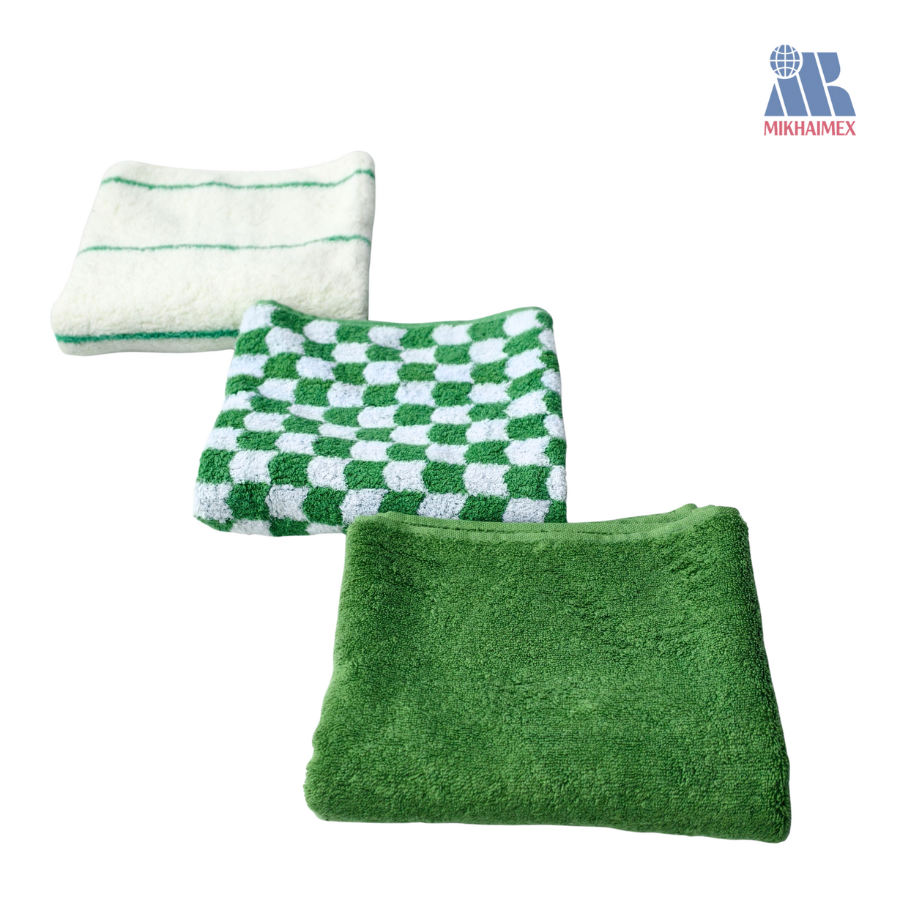
Premium Soft Line (Zero Twist Towels): The flagship product line demonstrating our mastery of Zero Twist technology. Woven from high-grade long-staple cotton, the products stand out for their velvet-like softness, ultra-fast absorbency, and superior quick-drying capability, ideal for the premium retail and spa markets. Hospitality Heavy GSM Towels: Focused on maximum durability and longevity. The towels are woven from Pima/Supima cotton, achieving high GSM (over 650 GSM), guaranteed to withstand frequent, high-intensity industrial washing, resulting in operational cost savings for 4-5 star hotel partners. Bio-Based and Functional Fiber Towels: Developing product lines from Tencel, Modal, or recycled fibers, meeting international sustainability standards (GOTS, Oeko-Tex), catering to export markets with high eco-friendly requirements.
Professional OEM/ODM Towel Weaving Services
Thanks to the closed-loop towel weaving process, Minh Khai Textile offers full-package contract manufacturing services, helping customers create exclusive towel brands:
In-Depth Technical Consultation: Supporting the integration of advanced technologies like Zero Twist technology into custom designs, ensuring optimal product performance. Comprehensive Customization: Accepting production orders customized from A-Z: GSM weight, Pantone dye colors, intricate Jacquard/Border logo embroidery/weaving, and packaging according to export specifications. The investment in advanced technologies like Zero Twist technology has helped Minh Khai Textile compete not only on price but also on product value and performance. This is a testament to the continuous innovation of a leading Vietnamese towel weaving brand, ready to deliver high-quality and economically efficient solutions to global partners.