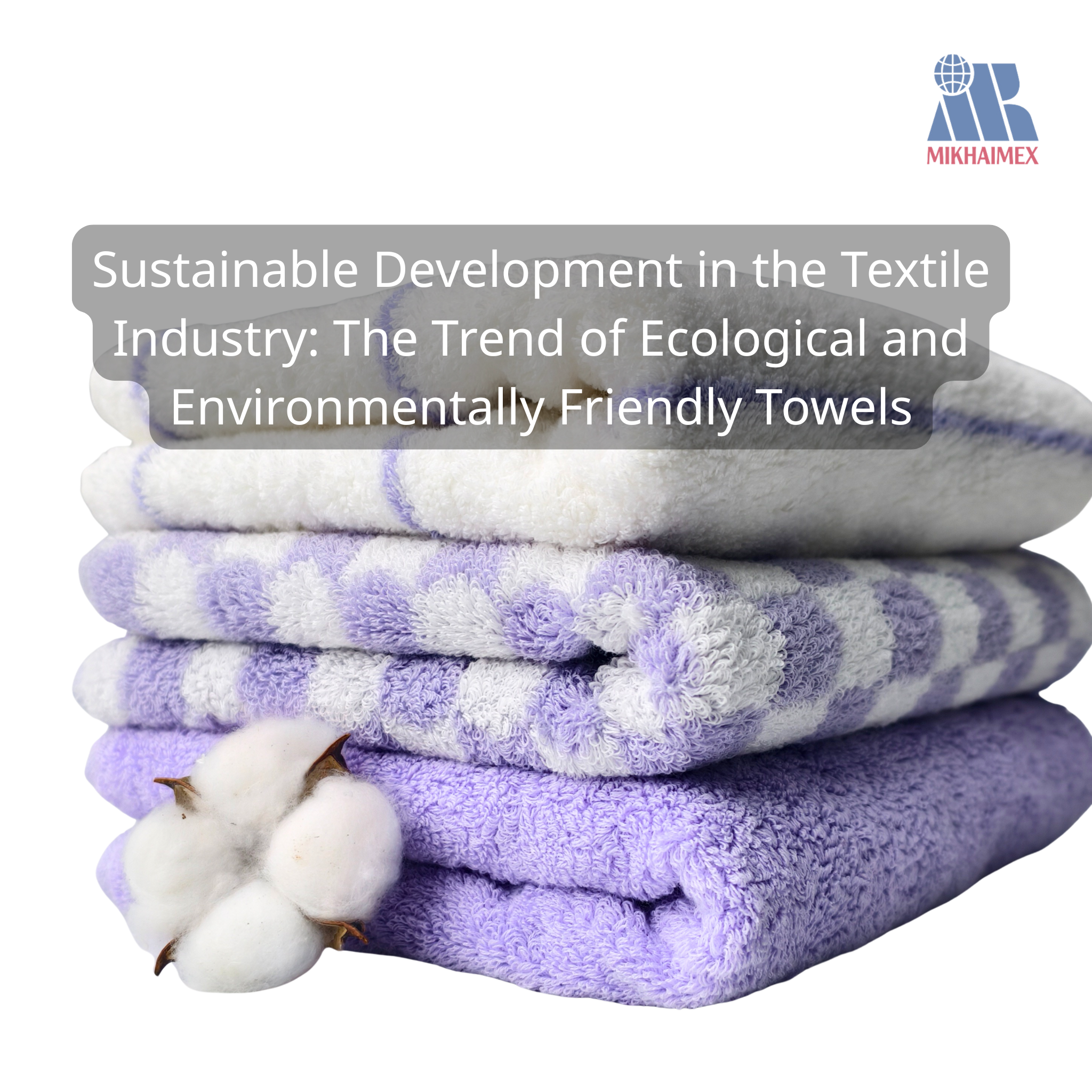
Sustainable Development in the Textile Industry: The Trend of Ecological and Environmentally Friendly Towels
1. Environmental Challenges of the Traditional Textile Industry and the Need for Sustainable Development
The textile and garment industry is one of the world’s leading resource-intensive and polluting industries, posing severe challenges to the global environment and climate. The production of traditional cotton towels, starting with cotton cultivation, is a prime example of an unsustainable exploitation model. To produce conventional cotton material, agriculture uses vast amounts of water – estimated up to 20,000 liters of water for one kilogram of cotton – along with large quantities of pesticides and chemical fertilizers. These chemicals not only degrade soil quality but also cause serious pollution of surface water systems, negatively impacting biodiversity and the health of farming communities.
The process of turning fiber into towels further exacerbates pollution levels. Stages such as bleaching, dyeing, and finishing require the use of a variety of chemicals, including heavy metals, synthetic dyes, and difficult-to-degrade organic compounds. Untreated industrial wastewater is often discharged into the environment, causing widespread water pollution. Furthermore, the textile industry is a major energy consumer, primarily from operating weaving machinery, drying, and heat treatment. The dependence on fossil fuels in production leads to significant greenhouse gas emissions, contributing to global warming. Due to these negative impacts, the transition to a sustainable development model is no longer an option but has become a prerequisite for the responsible existence and growth of the cotton towel industry.
2. Characteristics of Ecological Towels and Sustainable Raw Material Sourcing
Ecological, or sustainable, cotton towels represent a comprehensive commitment to production, extending beyond product quality to environmental and social responsibility. The core characteristics of this product lie in its material origin and processing methods.
The foundational material is Organic Cotton, grown without the use of any harmful agricultural chemicals such as pesticides, herbicides, or chemical fertilizers, and strictly prohibiting genetically modified seeds. Organic farming not only protects the health of farmers and the soil ecosystem but also significantly reduces water consumption compared to conventional cotton. Towel production from organic cotton must often strictly adhere to international standards such as GOTS (Global Organic Textile Standard), ensuring organic integrity throughout the supply chain.
In addition to organic cotton, the ecological towel trend also extends to renewable and recycled fibers. Recycled fibers include cotton recycled from garment scraps or old towels, which helps reduce the amount of textile waste dumped in landfills, or recycled synthetic fibers (such as polyester recycled from PET plastic bottles), reducing the need for new petroleum extraction. Renewable fibers like Lyocell (Tencel) and Modal, sourced from sustainably managed wood pulp, are notable for their closed-loop production processes, where solvents are recovered and reused almost completely. This diversity of sustainable materials allows manufacturers to create products that are not only environmentally friendly but also offer superior softness, antimicrobial properties, and absorbency. Technically, ecological towels must still meet high-quality metrics, such as a high GSM (Grams per Square Meter) index, ensuring product thickness, durability, and lifespan, thereby extending the usage cycle and reducing replacement frequency.
3. Clean Production Technology and Global Certification Standards
The processing stage is crucial for ensuring the ecological integrity of cotton towels. Sustainable textile factories must invest in clean production technology. Instead of using chlorine-based bleaching chemicals, manufacturers are switching to environmentally friendly bleaches, such as biological enzymes or Hydrogen Peroxide . In the dyeing stage, the use of dyes free of heavy metals and adherence to a strict Restricted Substances List (RSL) are mandatory. Low-water dyeing technologies, such such as digital printing or supercritical CO2 dyeing, are also being researched and implemented to minimize water consumption and pollution.
Water and energy management are central to green production. Pioneering factories install internal wastewater recycling systems, treating effluent to meet Class A or B standards before reuse in processes that require less purity, such as rough washing. Regarding energy, the transition to renewable energy sources, such as installing solar panels on factory roofs or utilizing biomass boiler systems, significantly helps reduce carbon emissions.
To confirm the sustainability and ethical nature of a product, third-party certifications are indispensable. Oeko-Tex Standard 100 is the basic standard ensuring the towel contains no harmful substances that affect human health. GOTS is a more comprehensive standard, requiring organic content and social responsibility throughout the entire supply chain. Additionally, Made In Green by Oeko-Tex provides a premium, traceable label, confirming that the product has been tested for harmful substances and produced in environmentally friendly and socially fair working conditions.
4. Economic Challenges and the Prospect of the Circular Economy
The transition to a sustainable towel production model offers many prospects but also comes with significant economic challenges. The initial investment costs in high-tech machinery, advanced wastewater treatment systems, and organic raw materials are often much higher than traditional production, leading to a higher final product price. Maintaining a stable, certified organic cotton supply also requires long-term, close cooperation with strictly controlled suppliers. However, in the long term, the sustainable model mitigates legal risks, enhances resource efficiency, and increases brand value.
The biggest prospect for the cotton towel industry is the adoption of the Circular Economy. This requires manufacturers to design towels from the outset to be easily recyclable at the end of their life cycle. For instance, designing towels using only a single type of fiber material (100% Cotton or 100% Tencel) instead of complex fiber blends makes sorting and recycling easier. After use, old towels can be collected, sorted, shredded, and recycled into new fibers for manufacturing new towels or other textile products, closing the resource loop, reducing landfill waste, and decreasing the need for virgin raw material extraction. Supply chain transparency through digital technology (e.g., Blockchain) is also a key factor, helping consumers trace the origin and verify product sustainability claims.
5. Minh Khai Textile: Implementing Sustainable Commitment in Towel Production

Following the analysis of the global sustainable development trend, it is important to examine how pioneering Vietnamese enterprises, especially in the cotton towel industry, are implementing these commitments. Minh Khai Textile (Minh Khai Textile Import-Export Joint Stock Company), with a history dating back to the 1960s, is one of the long-standing textile units in Hanoi, specializing in the direct and intensive production of cotton towels. Minh Khai has been asserting its position not only through product quality but also through an environmentally friendly production strategy.
Minh Khai Textile Import-Export Joint Stock Company (Mikhaimex) is recognized as a large-scale cotton towel manufacturer, offering a diverse range of towel products from face towels, bath towels, and high-end hotel towels to export products. Minh Khai’s production capacity is built on a closed production process (from spinning, weaving, dyeing, and finishing), which allows the company to strictly control product quality according to international technical standards (e.g., high GSM index, color fastness, absorbency) and export standards to demanding markets such as Japan, South Korea, the US, and the EU.
To materialize its strategy towards Green Production, Minh Khai Textile has implemented several solutions. The company is expanding the use of high-grade and environmentally friendly bio-based fibers such as Bamboo, Modal, and Tencel, aiming to mitigate the impacts of conventional cotton farming. In the production process, Minh Khai is committed to using safe chemical treatment techniques, such as biological enzyme bleaching instead of chlorine-based chemicals, and ensuring that dyes meet international safety standards, such as adherence to Oeko-Tex equivalent standards, free from toxic substances that cause skin irritation. Furthermore, Minh Khai also focuses on resource management, with solutions to optimize water and energy use in production. By combining extensive experience, modern textile technology, and a strong commitment to sustainable development, Minh Khai Textile is shaping the future of Vietnam’s cotton towel industry, moving towards a production base responsible for the environment and society, while creating safe and high-quality products for consumers.