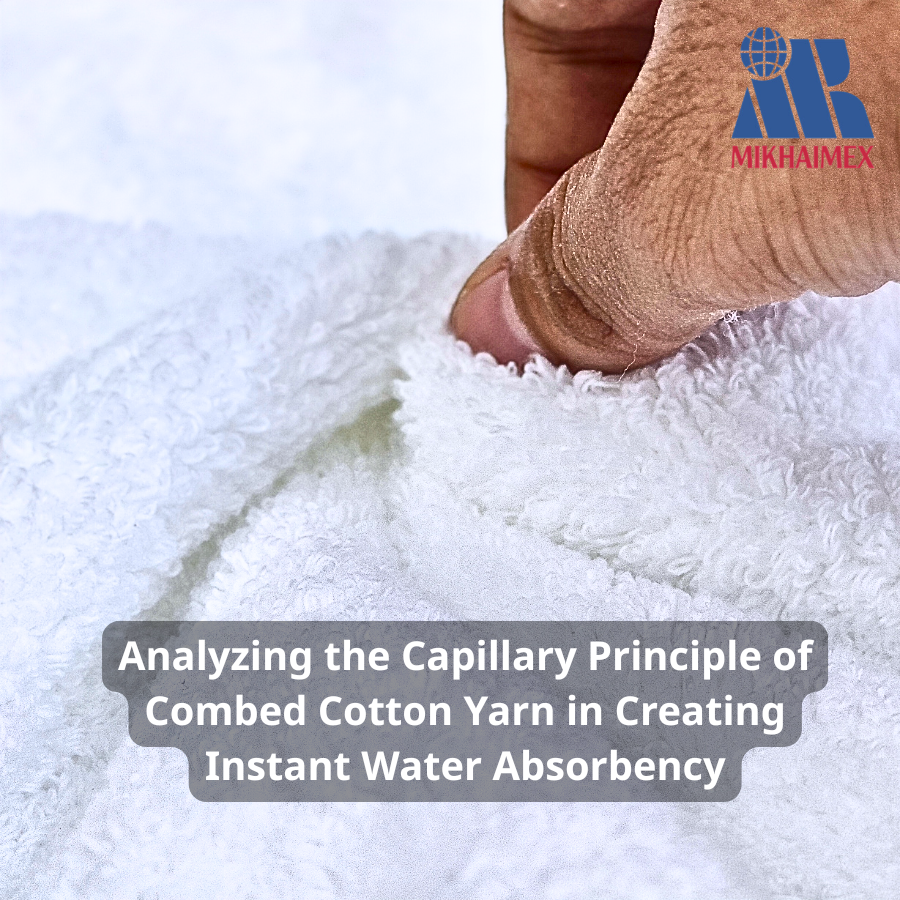
Analyzing the Capillary Principle of Combed Cotton Yarn in Creating Instant Water Absorbency
1. The Breakthrough of Fiber Processing Technology and the Role of Capillary Action in Consumer Experience
In modern textile manufacturing, water absorbency is not merely a basic technical property but has become the most important benchmark to evaluate the class of a premium terry towel. When contacting the skin after bathing or face washing, a high-quality towel must possess the ability to remove water droplets on the skin surface instantly without heavy rubbing that damages the epidermis. The secret behind that outstanding water retention performance does not lie in chemical softening additives or weaving aids, but is hidden directly within the physical structure of raw input materials. The appearance of combed cotton yarn has created a major turning point, fully applying the natural capillary principle to deliver the most perfect sensory experience for users. Analyzing deeply this physical mechanism helps us clearly understand why towel lines woven from this premium fiber source become the preferred choice for five-star hotel chains and modern families.
2. Technical Essence of the Combing Process Eliminating Short Fibers and Coarse Impurities
To create a fabric structure with superior water conduction capability, processing procedures at the factory must strictly comply with rigorous technical standards. Completely different from ordinary coarse spinning technologies that retain many short fibers and impurities, the manufacturing process of combed cotton yarn mandates passing cotton blanks through an exceptionally sophisticated combing machine system. This mechanical treatment acts as a perfect filter, thoroughly eliminating short easily broken cotton fibers, lint-prone strands, and all organic dust particles remaining in natural cotton bolls. The result obtained after processing combed cotton yarn is fabric strands possessing absolute length uniformity, smoothness, and superior resilience. When these standard cotton fibers are fed into weaving machines, they intertwine to construct a fabric surface with a homogeneous structure, avoiding crushed fibers and creating solid foundations for natural capillary tubes to maximize their utility.
3. Physical Capillary Mechanism and Instant Water Molecule Conduction in Fabric Layers
The capillary principle in textiles is the phenomenon where liquid automatically rises and adheres tightly into narrow micro-gaps thanks to surface attraction forces between the liquid and the solid structure of fabric fibers. Natural cotton fiber inherently contains very high cellulose content with countless hydrophilic hydroxyl groups capable of generating strong hydrogen bonds with surrounding water molecules. However, if cotton fibers are arranged disorderly or contain many short fibers, capillary pipelines will break or clog, significantly reducing water conduction speeds. Conversely, the smooth and straight structure of combed cotton yarn creates an exceptionally continuous and unobstructed micro-conduit system. When the towel surface touches water droplets, capillary forces inside the micro-voids of combed cotton yarn immediately act like a micro-pump, rapidly pulling water molecules deep into the yarn core and dispersing them evenly across the entire fabric surface area in just milliseconds.
4. Perfect Balance Between Peak Absorbency and Mechanical Durability Against Laundering Frequencies
A tricky puzzle for textile engineers is how to make towels absorb water extremely fast while still retaining resilient fabric shapes after hundreds of industrial wash cycles. Many towel lines woven from ordinary low-twist yarns absorb water well but are prone to fiber rotting, lint shedding, and structural distortion under high friction in washing machines. The birth of combed cotton yarn has thoroughly resolved this problem thanks to highly stable cellulose molecular bonds. Since short fibers are completely removed, the remaining long fibers in combed cotton yarn twist together tightly without needing excessive twisting force, helping fabric strands retain hollow air pockets inside to absorb water while withstanding excellently under mechanical pressure. Towels woven from combed cotton yarn do not become harsh, thin, or deformed over time, ensuring instant water absorbency performance is fully preserved throughout the product lifespan.
5. Superior Moisture Release Capacity Pushing Back Bacteria and Bathroom Mold Risks
Not stopping at instant water retention capacity, the continuous capillary structure of combed cotton yarn also brings an extremely important biological advantage, which is superior moisture self-releasing speed. In bathroom environments that are often humid and lack natural sunlight, towels holding water deep inside the yarn core become ideal grounds for bacteria and mold to multiply, causing unpleasant sour odors. Thanks to continuous micro-channels inside combed cotton yarn layers, natural air can easily circulate through the fabric surface, accelerating water evaporation speeds many times faster than ordinary towels. Utilizing towel lines woven from combed cotton yarn helps your family towels remain dry, fresh, and naturally sterilized, protecting the respiratory and skin health of users.
6. Minh Khai Textile Company – Pioneering the Application of Premium Fiber Weaving Technologies Meeting International Standards
Anticipating wise and strict market consumption trends, Minh Khai Textile Company has affirmed its position as a top manufacturer by adopting premium combed cotton yarn as the foundational material for all export terry towel lines. On synchronous weaving and dyeing technology lines imported from Europe, Minh Khai strictly controls every technical parameter from fiber density, twist level, to safe active dyeing processes. Towel products woven from combed cotton yarn under the Minh Khai brand proudly achieve prestigious OEKO-TEX certification, guaranteeing absolute benignness for the most sensitive skin types. With robust OEM/ODM processing capacity, Minh Khai Textile Company commits to accompanying B2B partners, hotel chains, and major brands in elevating product quality, bringing sustainable utility values and elevating life experiences for Vietnamese consumers.