ANALYSIS OF STRENGTHS AND WEAKNESSES: VIETNAMESE TOWEL INDUSTRY VS. ASIAN COMPETITORS
I. Competitive Landscape and Strategic Positioning of the Vietnamese Towel Industry
In the context of the global textile market undergoing a strong restructuring, Asia remains the main center for towel manufacturing. However, geopolitical factors, rising labor costs, and the increasing demand for compliance with Environmental, Social, and Governance (ESG) standards have prompted major buyers to review their sourcing strategies. This shift is not a complete replacement but a reallocation of risk and value.
Vietnam, despite lacking an advantage in domestic cotton resources, has seized this change. The strategy of the Vietnamese towel industry is clear: avoiding the price war with India and Pakistan, and instead focusing on the premium segment, where technical quality, supply chain stability, and adherence to international standards are the deciding factors. This positioning helps Vietnam’s towel industry become a “safe destination” on the Asian textile map, where brands are willing to pay a higher price to ensure stability and ethical production. An objective analysis of strengths and weaknesses is essential for the Vietnamese Towel Industry to maximize its advantages and mitigate risks, affirming its long-term position as the most reliable manufacturing partner.
II. Superior Strengths and Strategic Advantages of the Vietnamese Towel Industry
The Vietnamese Towel Industry possesses strategic competitive advantages, built upon an open trade policy and investment in the quality of manufacturing processes:
-
Exclusive Tariff Advantage (FTAs): This is the biggest advantage, providing direct economic value. Vietnam’s extensive network of Free Trade Agreements (FTAs), especially the CPTPP and EVFTA, provides an absolute preferential tariff rate when exporting to the US, Canada, Japan, and European markets. This advantage creates a difference in overall cost, allowing the Vietnamese Towel Industry to offset higher raw material input costs.
-
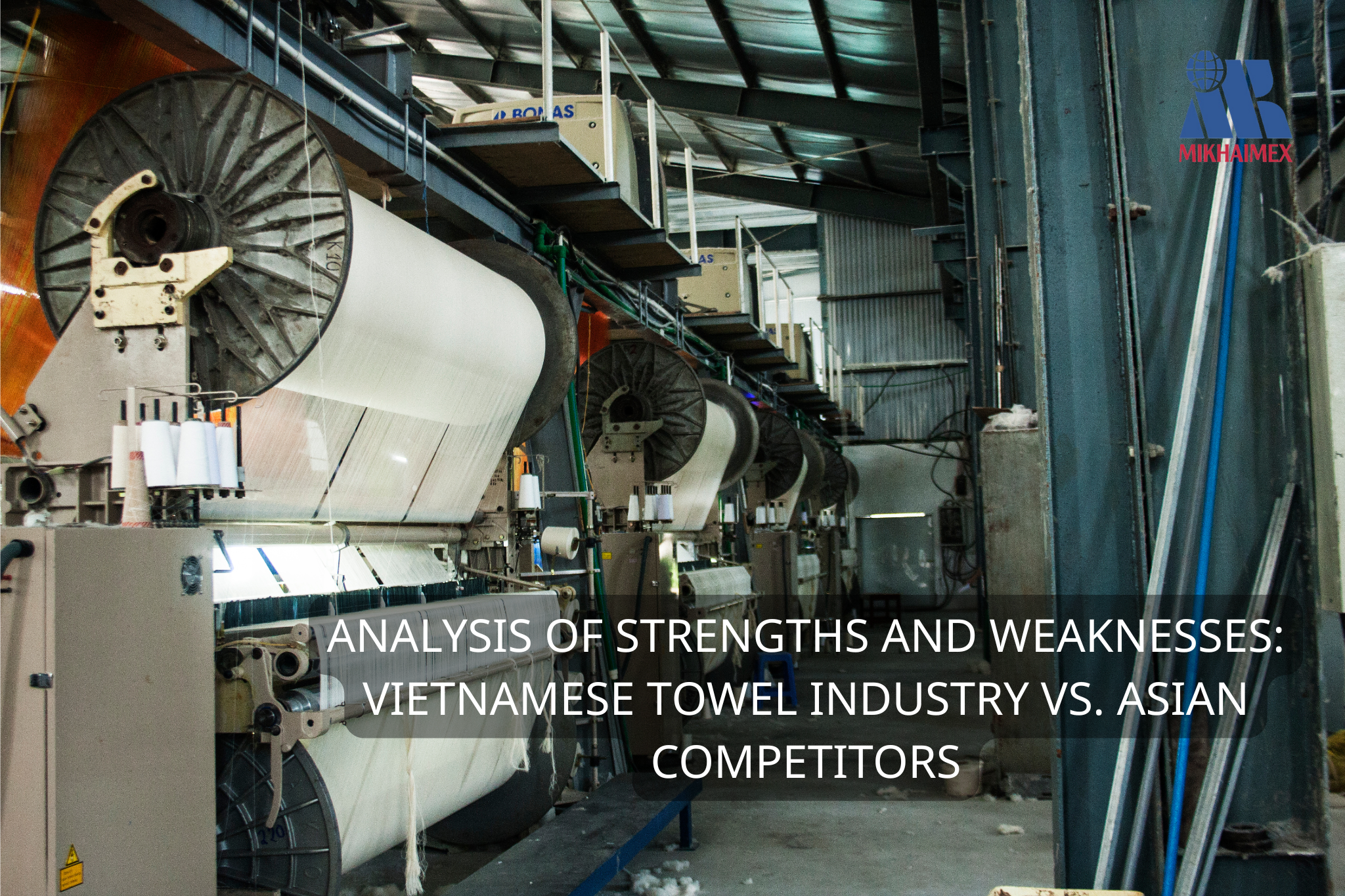
Stable and Consistent Technical Quality: Vietnamese towel enterprises often invest in modern weaving and dyeing machinery from Europe and Japan. This ensures highly uniform product quality, durable dye colors, and stable tensile strength. This stability is a key factor enabling the Vietnamese Towel Industry to pass stringent quality inspection barriers.
-
Strict Adherence to International Standards: The commitment to achieving certifications such as Oeko-Tex Standard 100, GOTS, and BSCI is a pivotal factor that makes the Vietnamese Towel Industry a reliable, safe, and responsible partner. This compliance stands out compared to many manufacturers in India and Pakistan, where chemical control and labor conditions are often less regulated.
-
Flexibility in High-Value Production and Innovation: Vietnamese towel factories are capable of quickly responding to complex OEM/ODM orders requiring high technical skill, such as jacquard logo weaving, or implementing new weaving technologies like zero twist. This allows international brands to effectively create exclusive products.
-
Stable Political and Economic Environment: Compared to the political instability or trade barriers encountered by competitors, Vietnam offers stability to global supply chains—a factor increasingly prioritized by major buyers.
III. Inherent Weaknesses and Challenges of the Vietnamese Towel Industry
Alongside its strategic strengths, the Vietnamese Towel Industry also faces major weaknesses and challenges that must be addressed to maintain its competitive edge:
-
High Dependence on Imported Raw Materials: Vietnam imports a large volume of cotton yarn (approx. 45%) from the US, India, Brazil, etc. This makes the Vietnamese Towel Industry’s production costs sensitive to global cotton price fluctuations and exchange rates, increasing input costs compared to competitors with domestic cotton sources. However, Vietnam is now strongly developing domestic cotton-growing areas for the textile industry. The trend towards self-sufficiency in raw materials is gradually replacing imported sources, increasing the competitiveness of Vietnamese towels.
-
Higher Labor and Operational Costs than Competitors: Labor costs in Vietnam, especially in major manufacturing hubs, are significantly higher than in India and Pakistan. Although offset by productivity and technical skill, this weakness makes it difficult for the Vietnamese Towel Industry to compete on price in the mass-market and high-volume segment.
-
Limitation in Large-Scale Production and Economies of Scale: The majority of Vietnamese towel enterprises are Small and Medium-sized Enterprises (SMEs), making it difficult to achieve economies of scale like the massive textile conglomerates in China. This affects the ability to quickly fulfill ultra-large orders.
-
Challenge of Rules of Origin: Despite having FTAs, importing raw materials from outside the bloc requires enterprises to invest in domestic yarn production or switch to synthetic/bio-based fibers to meet strict rules of origin, creating an added investment and research burden.
-
Challenge in Training High-Skilled Technical Human Resources: The Vietnamese Towel Industry requires highly specialized personnel in eco-dyeing techniques and the operation of high-tech machinery to maintain its leading position in quality.
IV. Comprehensive Comparison of Vietnamese Towel Industry with Key Competitors
To have a comprehensive view, we need to compare the Vietnamese Towel Industry with its main competitors based on core criteria:
First are India and Pakistan. Their competitive advantages are abundant domestic cotton supply, lowest cost, and large production scale. However, their main weaknesses are inconsistent quality, risks in standard compliance (Oeko-Tex, labor), and slow technological innovation. Their strategic positioning is high volume and low price (mass market segment), creating significant price pressure on the global market.
Next is China. Their advantages are advanced weaving technology, fast production speed, and product diversification capability. But they face the weaknesses of high labor costs, tariff barriers, and political risks. China’s strategic positioning is technology, speed, and functional products. The shift away from China creates a significant opportunity for the Vietnamese Towel Industry.
Finally, Vietnam. The competitive advantages of the Vietnamese Towel Industry are the FTA advantage (preferential tariffs), stable quality, and adherence to Oeko-Tex standards. The weaknesses are raw material dependence, higher labor costs than India/Pakistan, and smaller production scale. Vietnam’s strategic positioning is high quality, safety, and a reliable strategic partner.
Overall, the Vietnamese Towel Industry is situated in a strategic position, balancing European quality with Asian costs, making it the optimal choice for brands prioritizing reliability and standard compliance.
V. Minh Khai Textile: Turning Vietnamese Towel Strengths into an Exclusive Advantage
In this clear context of strengths and weaknesses, Minh Khai Textile Import-Export Joint Stock Company has built a strategy to maximize the advantages of the Vietnamese Towel Industry and minimize its weaknesses. Minh Khai does not compete on price but focuses exclusively on weaving premium towel lines, transforming the cost disadvantage into a quality advantage.
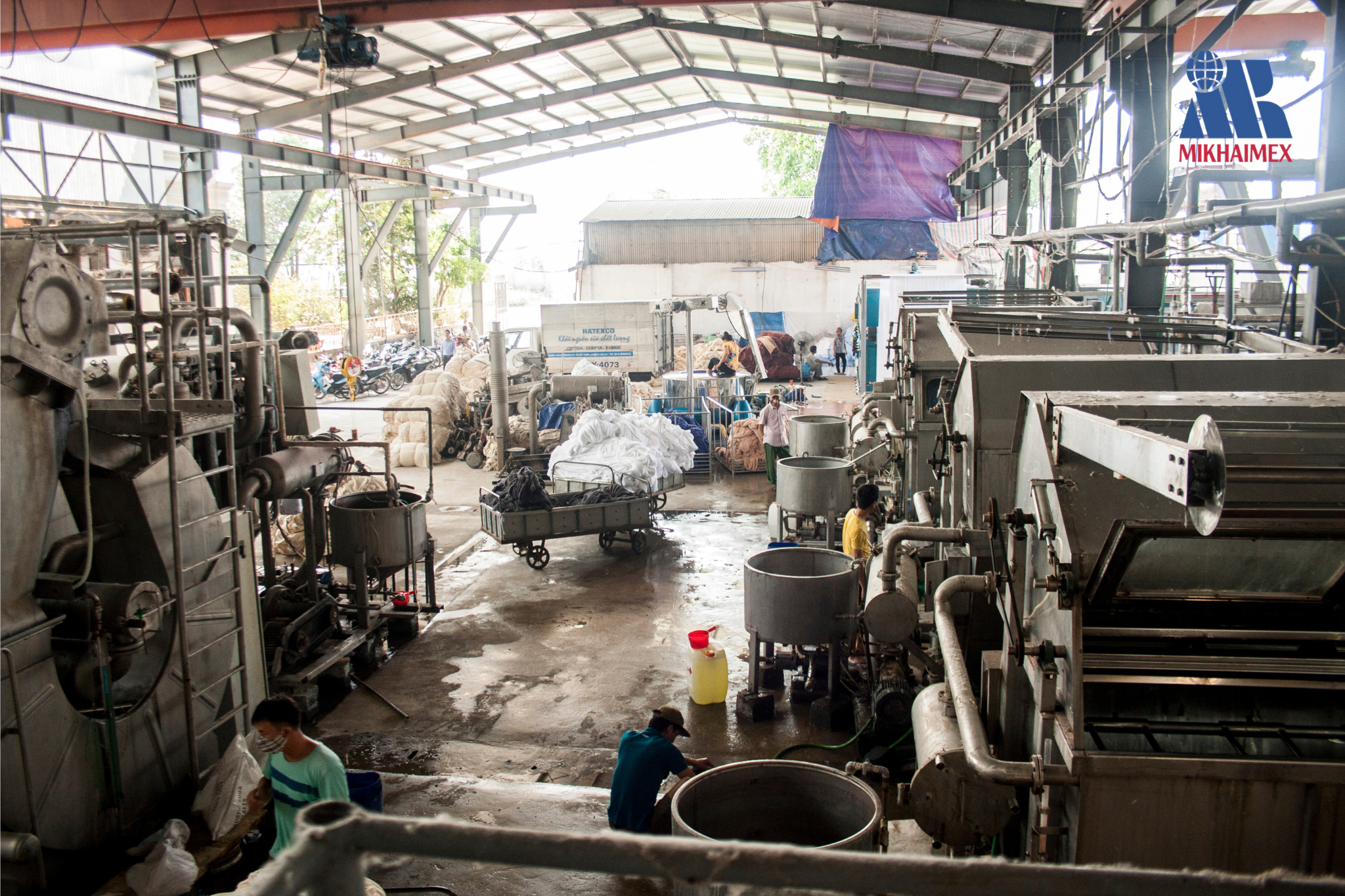
Minh Khai Textile prides itself on owning a closed-loop towel weaving process, ensuring absolute quality control, which addresses the regional weakness of inconsistent stability.
-
5-Star Hotel Towels: Minh Khai Textile specializes in weaving heavy GSM (above 650 GSM) towels, using 100% imported long-staple cotton. The product is specially treated to increase tensile strength and chemical resistance, addressing the cost disadvantage by increasing service life and optimizing the Life Cycle Cost (LCC) for customers.
-
High-Tech and Functional Fiber Towels: Minh Khai Textile invests in zero twist technology and weaves towel lines from bio-based fibers (Modal, Tencel). This overcomes the weakness in technological innovation, positioning the Vietnamese Towel Industry as a leader in performance and sustainability.
-
Custom Towels (OEM/ODM): Minh Khai offers comprehensive processing services. We not only weave towels according to technical requirements but also support exclusive pattern design, precise Pantone color dyeing, and sophisticated jacquard logo embroidery/weaving.
Commitment to Standards and Strategic Partnership
The entire towel weaving process at Minh Khai Textile strictly adheres to Oeko-Tex Standard 100. This focus on stable technical quality, flexible service, and standard compliance has helped Minh Khai Textile reinforce the Vietnamese Towel Industry’s position in the high-value segment, delivering superior reliability compared to competitors.
Choosing Minh Khai Textile is choosing stability, superior technical quality, and fully capitalizing on the trade advantages of the Vietnamese Towel Industry.